

Broken Circle Mathematics Formative Assessment Answers
Know the formulas for the area and circumference of a circle and use them to solve problems; give an informal derivation of the relationship between the circumference and area of a circle.
General Information
Subject Area: Mathematics
Grade: 7
Domain-Subdomain: Geometry
Cluster: Level 2: Basic Application of Skills & Concepts
Date Adopted or Revised: 02/14
Date of Last Rating: 02/14
Status: State Board Approved
Test Item Specifications
- Assessment Limits :
Circles are limited to whole circles and semicircles.
- Calculator :
Yes
- Context :
Allowable
Sample Test Items (4)
- Test Item #: Sample Item 1
- Question:
A circle with its dimensions, in centimeters (cm), is shown.

What is the area, in square centimeters, of the circle?
- Difficulty: N/A
- Type: EE: Equation Editor
- Test Item #: Sample Item 2
- Question: A circle with its dimensions, in inches (in.), is shown.

What is the area, in square inches, of half the circle?
- Difficulty: N/A
- Type: EE: Equation Editor
- Test Item #: Sample Item 3
- Question: Mark placed a pool in his backyard, which is enclosed by a triangular fence.
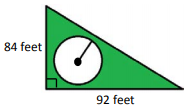
The radius of the pool is 20.5 feet. How much of the backyard area is not covered by the pool?
- Difficulty: N/A
- Type: EE: Equation Editor
- Test Item #: Sample Item 4
- Question:
The circumference of a circle is 53.38 centimeters.
What is the area in square centimeters? Use 3.14 for

- Difficulty: N/A
- Type: EE: Equation Editor
Related Access Points
Alternate version of this benchmark for students with significant cognitive disabilities.
Related Resources
Vetted resources educators can use to teach the concepts and skills in this benchmark.
STEM Lessons - Model Eliciting Activity
Bubble Burst Corporation's Chewing Gum Prototypes:
Students will calculate unit rate & circumference, compare & order decimals, convert metric units, and round decimals. Bubble Burst Corporation has developed some chewing gum prototypes and has requested the students to assist in the selection of which gum prototypes will be mass produced by using both quantitative and qualitative data to rank the prototypes for Bubble Burst Corporation.
Model Eliciting Activities, MEAs, are open-ended, interdisciplinary problem-solving activities that are meant to reveal students' thinking about the concepts embedded in realistic situations. Click here to learn more about MEAs and how they can transform your classroom.
Installing Tile Floor:
This MEA requires students to formulate a comparison-based solution to a problem involving finding the best plan for installing tile floor considering different aspects. Students are provided the context of the problem, a request letter from a client asking them to provide a recommendation, and data relevant to the situation. Students utilize the data to create a defensible model solution to present to the client.
Model Eliciting Activities, MEAs, are open-ended, interdisciplinary problem-solving activities that are meant to reveal students' thinking about the concepts embedded in realistic situations. Click here to learn more about MEAs and how they can transform your classroom.
MFAS Formative Assessments
Broken Circles:
Students are asked to complete and explain an informal derivation of the relationship between the circumference and area of a circle.
Circle Area Formula:
Students are asked to write the formula for the area of a circle, explain what each symbol represents, and label the radius on a diagram.
Circumference Formula:
Students are asked to write the formula for the circumference of a circle, explain what each symbol represents, and label the variables on a diagram.
Original Student Tutorials Mathematics - Grades 6-8
Pizza Pi: Area:
Explore how to calculate the area of circles in terms of pi and with pi approximations in this interactive tutorial. You will also experience irregular area situations that require the use of the area of a circle formula.
Pizza Pi: Circumference:
Explore the origins of Pi as the ratio of Circumference to diameter of a circle. In this interactive tutorial you'll work with the circumference formula to determine the circumference of a circle and work backwards to determine the diameter and radius of a circle.
Swimming in Circles:
Learn to solve problems involving the circumference and area of circle-shaped pools in this interactive tutorial.
Student Resources
Vetted resources students can use to learn the concepts and skills in this benchmark.
Original Student Tutorials
Pizza Pi: Circumference:
Explore the origins of Pi as the ratio of Circumference to diameter of a circle. In this interactive tutorial you'll work with the circumference formula to determine the circumference of a circle and work backwards to determine the diameter and radius of a circle.
Type: Original Student Tutorial
Pizza Pi: Area:
Explore how to calculate the area of circles in terms of pi and with pi approximations in this interactive tutorial. You will also experience irregular area situations that require the use of the area of a circle formula.
Type: Original Student Tutorial
Swimming in Circles:
Learn to solve problems involving the circumference and area of circle-shaped pools in this interactive tutorial.
Type: Original Student Tutorial
Perspectives Video: Expert
Problem-Solving Task
Eight Circles:
Students are asked to find the area of a shaded region using a diagram and the information provided. The purpose of this task is to strengthen student understanding of area.
Type: Problem-Solving Task
Tutorials
Circumference of a Circle:
This video shows how to find the circumference, the distance around a circle, given the area.
Type: Tutorial
Area of a Circle:
In this video, watch as we find the area of a circle when given the diameter.
Type: Tutorial
Virtual Manipulative
Circle Tool:
This applet allows students to investigate the relationships between the area and circumference of a circle and its radius and diameter. There are three sections to the site: Intro, Investigation, and Problems.
- In the Intro section, students can manipulate the size of a circle and see how the radius, diameter, and circumference are affected. Students can also play movie clip to visually see how these measurements are related.
- The Investigation section allows students to collect data points by dragging the circle radius to various lengths, and record in a table the data for radius, diameter, circumference and area. Clicking on the x/y button allows students to examine the relationship between any two measures. Clicking on the graph button will take students to a graph of the data. They can plot any of the four measures on the x-axis against any of the four measures on the y-axis.
- The Problems section contains questions for students to solve and record their answers in the correct unit.
(NCTM's Illuminations)
Type: Virtual Manipulative
Parent Resources
Vetted resources caregivers can use to help students learn the concepts and skills in this benchmark.
Perspectives Video: Expert
Problem-Solving Task
Eight Circles:
Students are asked to find the area of a shaded region using a diagram and the information provided. The purpose of this task is to strengthen student understanding of area.
Type: Problem-Solving Task
Video/Audio/Animation
Story of Pi:
This video dynamically shows how Pi works, and how it is used.
Type: Video/Audio/Animation
Virtual Manipulative
The Circle:
This interactive lesson introduces students to the circle, its attributes, and the formulas for finding its circumference and its area. Students then perform a few calculations to practice finding the area and circumference of circles, given the diameter.
Type: Virtual Manipulative
Broken Circle Mathematics Formative Assessment Answers
Source: https://www.cpalms.org/PreviewStandard/Preview/5477
Posted by: barberfolve1970.blogspot.com
0 Response to "Broken Circle Mathematics Formative Assessment Answers"
Post a Comment