

What Is The Atomic Makeup Of The Sun
The sun's atmosphere: Photosphere, chromosphere and corona
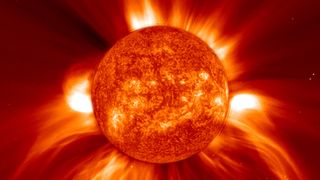
The sun'due south temper is made upwardly of several layers, mainly the photosphere, the chromosphere and the corona.
It'due south in these outer layers that the lord's day'south energy, which has bubbled upwards from the sun'due south interior layers over the class of a 1000000 years, is detected every bit sunlight, according to University Corporation for Atmospheric Research (UCAR (opens in new tab)).
Related: How far is Earth from the sun? (opens in new tab)
The sun'southward photosphere
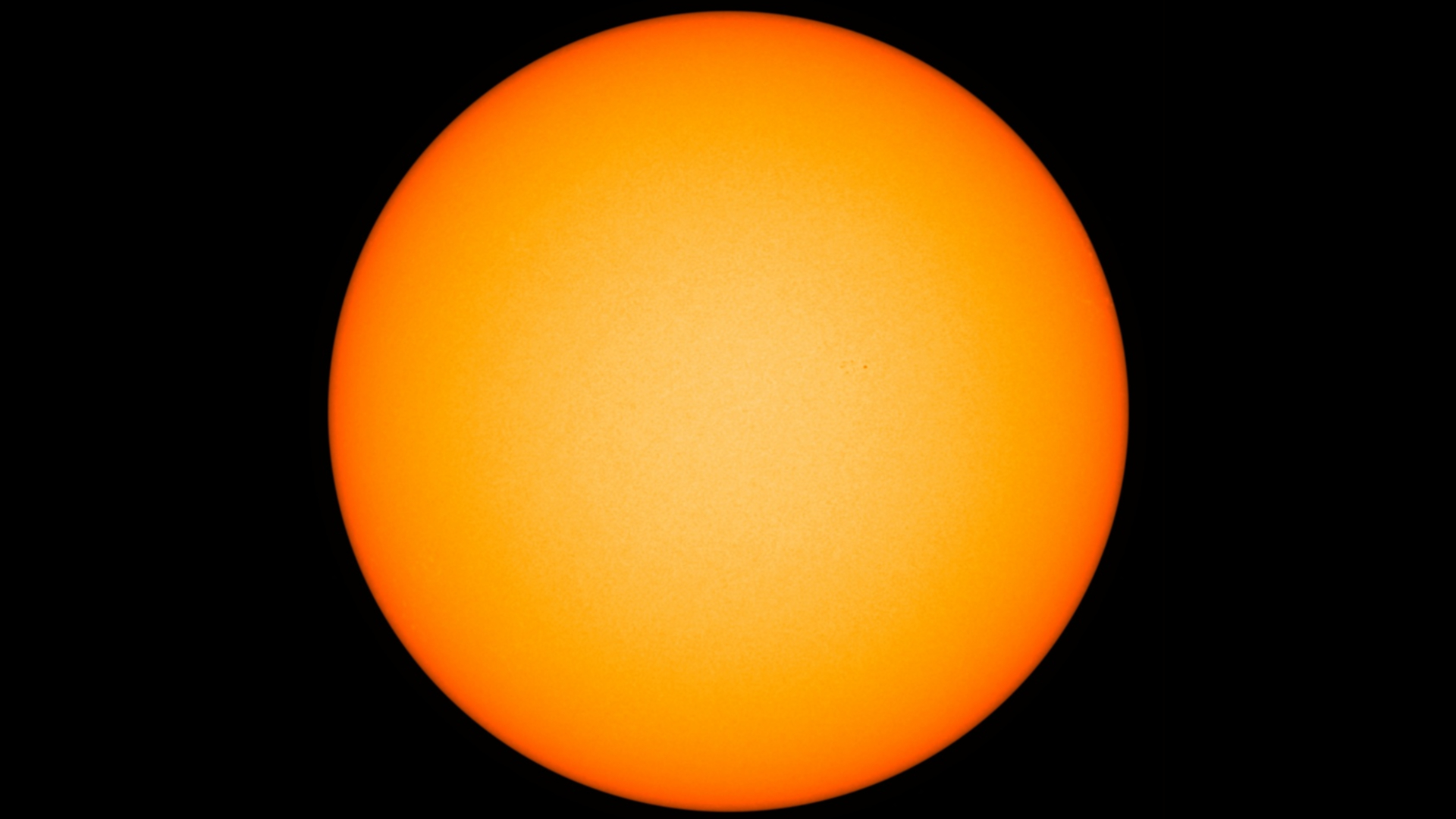
The photosphere is the lowest layer of the sunday's temper — the innermost layer we can observe directly. The term photosphere means "sphere of lite" and is the layer where nigh of the sun'due south energy is emitted. Information technology takes about eight minutes for sunlight from the photosphere to accomplish Earth.
The temperature of the photosphere ranges from 11,000 degrees Fahrenheit (6,125 degrees Celsius) at the bottom to vii,460 F (4,125 C) at the top. The photosphere is significantly cooler than temperatures at the sunday's cadre, which tin achieve nearly 27 million F (fifteen million C) according to NASA (opens in new tab). The sun's photosphere is about 300 miles (500 kilometers) thick, which is relatively thin when compared with the 435,000 miles (700,000 km) radius of the lord's day.
The photosphere is marked past brilliant, bubbling granules of plasma and darker, cooler sunspots, which emerge when the sun's magnetic field breaks through the surface. Sunspots announced to move beyond the sun's disk. Observing this motion led astronomers to realize that the lord's day rotates on its centrality. Since the sun is a ball of gas with no solid form, different regions rotate at different rates. The sun's equatorial regions rotate in about 24 days, while the polar regions take more than 30 days to brand a complete rotation.
The photosphere is also the source of solar flares: tongues of fire that extend hundreds of thousands of miles higher up the sun's surface. Solar flares produce bursts of Ten-rays (opens in new tab), ultraviolet radiation (opens in new tab), electromagnetic radiation (opens in new tab) and radio waves (opens in new tab).
The sun's chromosphere
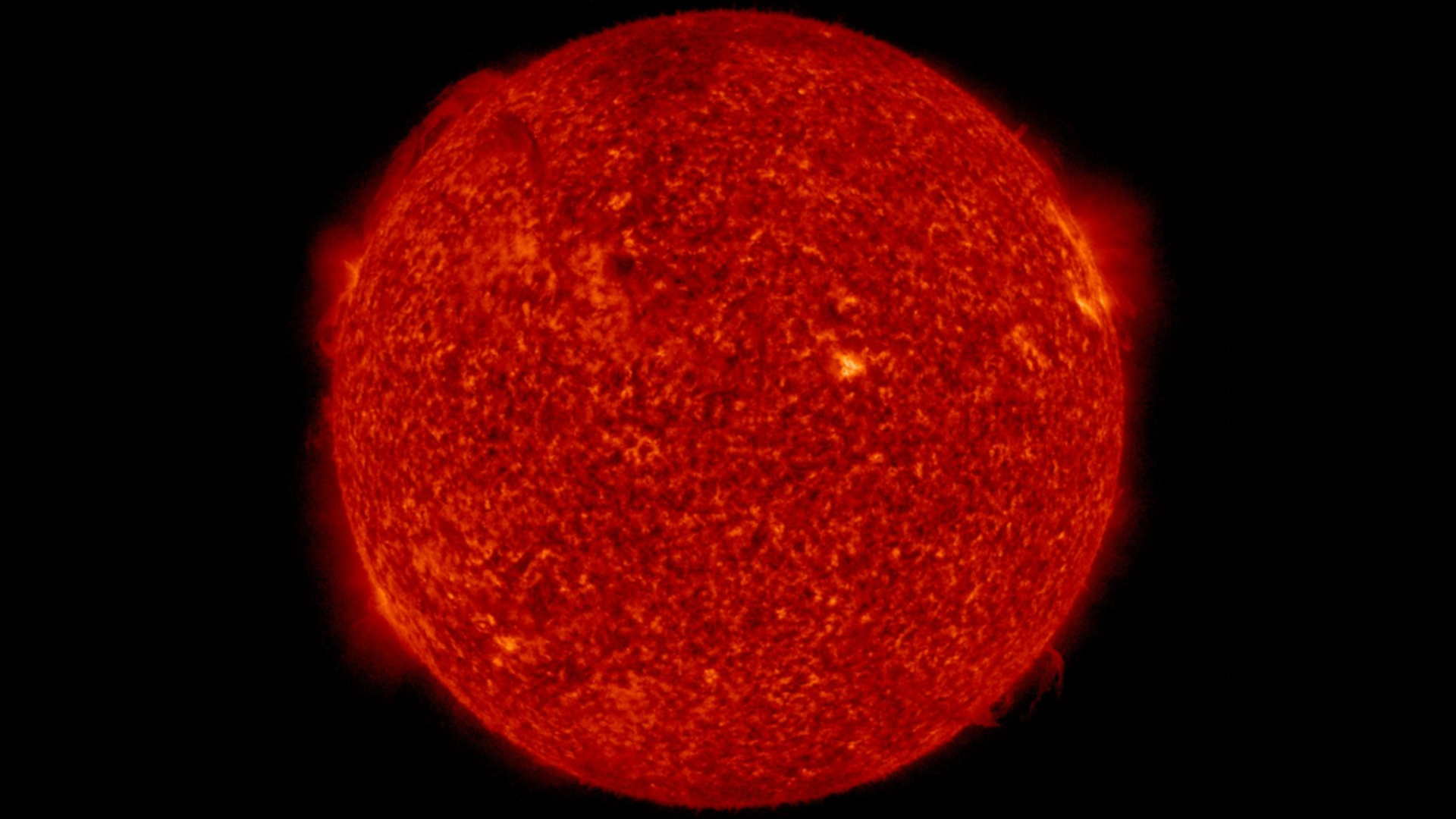
The layer above the photosphere is the chromosphere. The chromosphere emits a ruddy glow as super-heated hydrogen burns off. But the cherry rim tin can only be seen during a total solar eclipse. At other times, calorie-free from the chromosphere is ordinarily too weak to be seen against the brighter photosphere.
The chromosphere may play a role in conducting heat from the interior of the dominicus to its outermost layer, the corona. "We see certain kinds of solar seismic waves channeling upwards into the lower atmosphere, called the chromosphere, and from there, into the corona," Junwei Zhao, a solar scientist at Stanford University in Stanford, California, and lead author of a written report that tracked waves from sunspots said in a statement (opens in new tab). "This research gives usa a new viewpoint to await at waves that can contribute to the free energy of the atmosphere."
The sun's corona
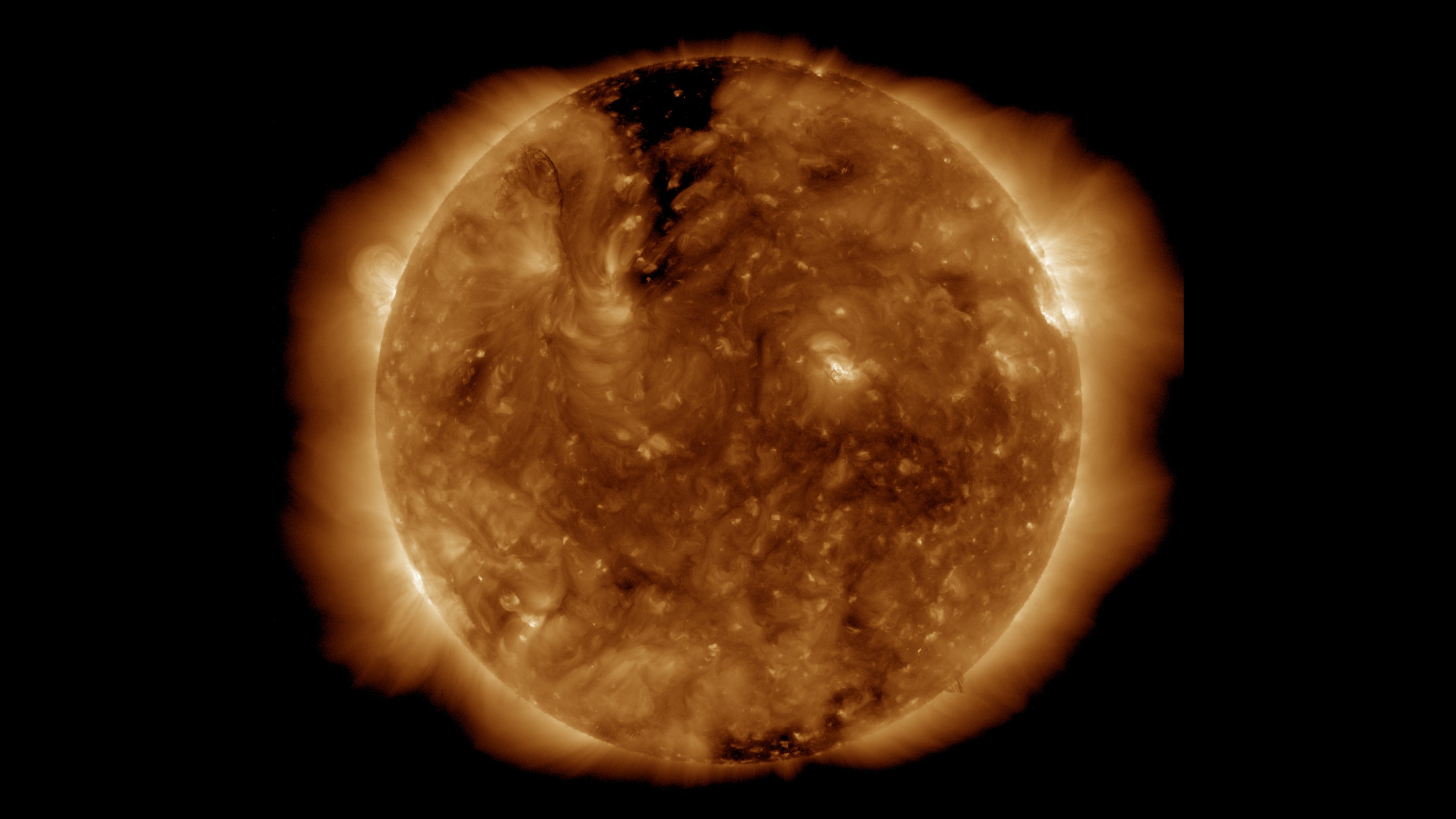
The third layer of the sun'southward atmosphere is the corona. Similar the chromosphere, the sun'southward corona can only be seen during a total solar eclipse (or with NASA'southward Solar Dynamics Observatory (opens in new tab)). It appears as white streamers or plumes of ionized gas that flow outward into space. Temperatures in the lord's day's corona (opens in new tab) tin can get as loftier every bit 3.5 million degrees F (2 million degrees C. As the gases cool, they become the solar wind.
Why the corona is up to 300 times hotter (opens in new tab) than the photosphere, despite being further from the solar core, has remained a long-term mystery.
"That's a bit of a puzzle," Jeff Brosius, a space scientist at Catholic University in Washington, D.C., and NASA'south Goddard Space Flight Center in Greenbelt, Maryland, said in a statement. "Things commonly get cooler farther abroad from a hot source. When you're roasting a marshmallow yous move it closer to the burn to cook it, not farther away."
Research suggests that tiny explosions known equally nanoflares may aid push the temperature up by providing sporadic bursts reaching up to 18 million F (10 million C).
"The explosions are called nanoflares because they have one-billionth the energy of a regular flare," Jim Klimchuk, a solar scientist at NASA's Goddard Infinite Flight Center (opens in new tab) in Maryland, said in a statement. "Despite being tiny by solar standards, each packs the wallop of a x-megaton hydrogen bomb. Millions of them are going off every 2d beyond the sunday, and collectively they heat the corona."
Giant super-tornados may besides play a role in heating the sun's outer layer. These solar twisters are a combination of hot-flowing gas and tangled magnetic field lines, ultimately driven by nuclear reactions in the solar core.
"Based on the detected events, we estimate that at least eleven,000 swirls are present on the sunday at all times," Sven Wedemeyer-Böhm, a solar scientist at the University of Oslo in Norway and pb author of the squad that identified tornados on the sun, told Space.com (opens in new tab).
Contempo research suggests that solar "campfires" — miniature solar flares discovered by the European-U.Due south. Solar Orbiter (opens in new tab) mission could be backside the mysterious heating of the sun's corona (opens in new tab).
The sun'southward atmosphere: Latest enquiry
In 2016, NASA's Solar Dynamics Observatory and the Solar Heliospheric Observatory observed a large "missing link" explosion on the lord's day. The event showed characteristics of three different types of solar eruptions that usually happen separately just occurred together this time, Infinite.com previously reported (opens in new tab). Scientists are studying the unique result to uncover new information almost what causes these powerful solar eruptions and how nosotros might be able to ameliorate predict them in the time to come.
On July 3, 2021, the sun surprised everyone with an enormous solar flare — the largest since 2017. The solar flare occurred from a sunspot called AR2838, Space.com reported. (opens in new tab)The flare was so large information technology caused a brief radio coma on Globe according to officials (opens in new tab).
Additional resource
Learn more most solar physics with NASA'southward Marshall Space Flight Middle. (opens in new tab) Discover how NASA'due south Solar Dynamic Observatory (opens in new tab) sees the sun. Explore the sun with NASA's Parker Solar Probe'south latest mission news (opens in new tab).
Bibliography
Aschwanden, Markus J. "The Tranquility-Sun Corona." (opens in new tab) New Millennium Solar Physics. Springer, Cham, 2019. 219-259.
Stangalini, Marco, et al. "Torsional oscillations within a magnetic pore in the solar photosphere." (opens in new tab) Nature Astronomy (2021): ane-6.
"The Sun'due south temper is hundreds of times hotter than its surface — hither'south why" (opens in new tab), The Conversation.
Bring together our Infinite Forums to keep talking space on the latest missions, night sky and more than! And if you have a news tip, correction or annotate, let us know at: community@space.com.
Source: https://www.space.com/17160-sun-atmosphere.html
Posted by: barberfolve1970.blogspot.com
0 Response to "What Is The Atomic Makeup Of The Sun"
Post a Comment